
The Symbol of Vancoderm Academy 
Campus facilities & Student services:
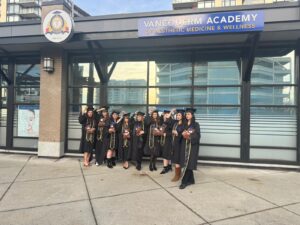 Physical facilities, Learning spaces, Types of Equipment, Machines, Devices, and Tools, Student-access areas, Administrative services:
Vancoderm Academy operates from a professional training facility in Vancouver, British Columbia. The campus includes: Dedicated classroom space for theoretical instruction(Two Rooms, and one Hall), Practical training rooms equipped with industry-standard aesthetic equipment( rooms), Clinical treatment beds, Medical Aesthetics Machines, Devices, Tools, like Medical Cosmetic Lasers, Radiofrequency Machines, Sublime, Sublative, IPL, Narrowband IPL, Microneedling, Dermal Pen, Mesotherapy, Trichology Room and set up, Body Contouring machines, and sanitation stations(Disinfection and Sanitation Room), Reception (Front Desk) and administrative office (Office), Student waiting area (Student Reception Hall, Three Student Stations, and a Student Room Washroom facilities( Two Washrooms, one for Students, one for staff), First aid kit, Fire Extinguisher, Laser Safety Signs, and posted emergency procedures.
All instructional equipment is maintained in accordance with applicable health, safety, and sanitation standards.
 Education/program progression assistance:
Academic Support Services:
Vancoderm Academy is committed to supporting student academic success throughout the duration of each program. Academic support services include:
- Instructor consultation during and outside scheduled class hours (by appointment)
- Student Gap Analysis (Subject to Subject), Ongoing feedback regarding academic performance
- Review and clarification of course materials ( Institutional Authored Text- books) and learning objectives
- Guidance regarding program progression and completion requirements
- Academic advising where a student is experiencing difficulty meeting course outcomes
- Students who encounter academic challenges are encouraged to meet with their instructor or administration to discuss available support options.
- All academic support is provided in accordance with institutional policies.
Orientation Program for New Program
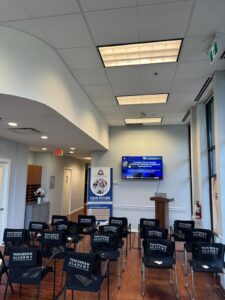 Orientation Program for New Programs – Detailed Overview
The Orientation Program is designed to ensure that all newly enrolled students are fully informed, prepared, and supported prior to commencing their studies at Vancoderm Academy of Aesthetic Medicine and Wellness.
Campus Introduction and Facilities Tour
Students receive a guided tour of the campus, including classrooms, clinical training areas, student lounges, administrative offices, sanitation stations, emergency exits, and safety equipment locations. Facility usage protocols, clinical hygiene standards, and access procedures are clearly explained.
Regulatory and Policy Review
A structured review of institutional policies is conducted, including:
- Student Handbook and institutional policies
- Student Statement of Rights and Responsibilities
- Code of Conduct and professional behavior standards
- Attendance and academic progress requirements
- Grading system and evaluation methods
- Academic integrity and plagiarism policy
- Harassment, discrimination, and respectful workplace policy
- Health and safety protocols
- Complaint resolution procedures
- Refund and withdrawal policies
Students are provided with the opportunity to ask questions and must acknowledge receipt and understanding of key policies.
Program-Specific Information
A comprehensive overview of the program is presented, including:
- Program objectives and learning outcomes
- Curriculum structure and course sequencing
- Theory-to-practice ratio
- Clinical/practicum requirements
- Required competencies and performance expectations
- Examination procedures and certification criteria
- Required uniforms, professional appearance standards, and equipment
- Scope of practice considerations relevant to aesthetic medicine and wellness
Academic and Student Support Services
Students are informed about available supports, including:
- Academic advising
- Instructor office hours
- Learning resources
- Career guidance and employability preparation
- Interview preparation and resume support
- Student wellness support resources
Health, Safety, and Emergency Preparedness
Emergency procedures are reviewed, including evacuation routes, first aid protocols, incident reporting procedures, and infection prevention and control standards applicable to clinical environments.
Technology and Systems Orientation
Students receive guidance on:
- Email communication expectations
- Learning management system (if applicable)
- Attendance tracking system
- Payment procedures and financial policies
- Distribution of Student Materials
- Students are provided with orientation packages, which may include:
- Official student bag
- Program syllabus and academic calendar
- Required textbooks or digital access codes
- Clinical supplies (if applicable)
- Identification badge
- Uniform guidelines
- Policy acknowledgment forms
- Professional Expectations
The orientation reinforces professional conduct, confidentiality obligations, ethical standards, and the importance of maintaining a safe, respectful, and inclusive learning environment.
Acknowledgment and Documentation
Students sign confirmation forms acknowledging participation in orientation and receipt of institutional policies and materials.
This structured orientation ensures regulatory compliance, promotes transparency, and supports student readiness for successful program completion.
Housing Assistance:

- Affordable Rental Housing
- Rental and Affordable Housing – Province of British Columbia
- Residential Tenancy Act (RTA), British Columbia
- Governs all landlord-tenant relationships in BC, including Vancouver.
- Covers: security deposits, rent increases, notice requirements, maintenance obligations, dispute resolution, tenant rights, eviction rules.
- Source: BC Government – Residential Tenancy Branch
- Residential Tenancy Branch (RTB), BC
- Provides official forms, dispute resolution, and guidance for tenants.
- Source: RTB Official Website
- BC Housing Resources
- Offers general guidance for locating safe and legal housing.
- Source: BC Housing – Renting in BC
Housing Assistance & Tenancy Information
Housing Arrangements
Vancoderm Academy does not provide on-campus housing. Students are responsible for arranging their own accommodation.
Students are encouraged to secure housing before program commencement and to review tenancy rights and responsibilities under British Columbia law.
Residential Tenancy Act (British Columbia)
Most rental housing in Vancouver is governed by the Residential Tenancy Act (RTA) of British Columbia.
The RTA outlines the legal rights and responsibilities of landlords and tenants, including:
- Security deposit limits
- Rent increase regulations
- Notice requirements
- Maintenance obligations
- Eviction procedures
- Dispute resolution process
- Students are encouraged to review official information provided by the Residential Tenancy Branch (RTB) of British Columbia.
Official information is available through the Government of British Columbia website.
Tenancy Agreements (Rental Contracts)
 Before signing a rental agreement, students should ensure:
-
The agreement is in writing
-
The monthly rent amount is clearly stated
-
The amount of the security deposit complies with BC law (maximum 50% of one month’s rent)
-
The start date and terms of tenancy are clearly outlined
-
Rules regarding utilities and additional charges are specified
Tenants should retain a signed copy of their tenancy agreement.
Security Deposits & Rent Increases
Under BC law:
-
A landlord may request a security deposit of up to 50% of one month’s rent
-
Rent increases are regulated and must follow provincial guidelines
-
Written notice is required before rent increases
Students are encouraged to verify current regulations directly with the Residential Tenancy Branch.
Tenant Rights
Tenants in British Columbia have the right to:
-
A safe and habitable living environment
-
Privacy and reasonable notice before landlord entry
-
Protection against unlawful eviction
-
Access to dispute resolution through the Residential Tenancy Branch
Ending a Tenancy
Notice requirements vary depending on the type of tenancy agreement. Students should review official guidelines before ending a lease to avoid financial penalties.
Dispute Resolution
If a dispute arises between a tenant and landlord, tenants may apply for dispute resolution through the Residential Tenancy Branch.
Housing Resources
Students may consult the following types of resources:
-
Government housing information portals
-
Residential Tenancy Branch of British Columbia
-
BC Housing
-
Reputable rental listing platforms
Vancoderm Academy does not endorse specific landlords or rental agencies and is not responsible for housing arrangements made by students.
Important Disclaimer
The information above is provided for general guidance only. Students are responsible for reviewing official government sources to ensure they understand their rights and obligations under British Columbia law.
Health / Safety / Mental health Resources:
 1-Understand how health care is delivered in B.C. :
2-Apply for health and drug coverage
Pays for medically required services of physicians and surgeons, and dental or oral surgery performed in a hospital. B.C. residents must by law enrol in MSP. You must physically be in B.C. to enrol in MSP.
4- Fair Pharmacare: Fair PharmaCare helps B.C. families pay for many prescription drugs, dispensing fees, and some medical devices and supplies. The less a family earns, the more help they get. A family can be a single person or a couple, with or without children.
Medical Services Plan (MSP) supplementary benefits provide partial payment for certain medical services obtained in British Columbia and may provide access to other income-based programs. MSP supplementary benefits support the following services from approved providers:
- acupuncture
- chiropractic
- massage therapy
- naturopathy
- physical therapy; and
- non-surgical podiatry
Those who may be eligible for MSP coverage of these supplementary benefit services include:
- Those who have applied and been deemed eligible based on their annual net income
- Income Assistance recipients
- Convention refugees
- Inmates of B.C. Correctional Facilities
- Individuals enrolled with MSP through the At Home Program
- Residents of long term care facilities receiving the Guaranteed Income Supplement (GIS)
- Individuals enrolled with MSP as Mental Health Clients; and
- First Nations individuals with valid B.C. Medical Plan coverage through the First Nations Health Authority
For these MSP beneficiaries, MSP contributes $23 per visit for a combined annual limit of 10 visits each calendar year for the following services from approved providers: acupuncture, chiropractic, massage therapy, naturopathy, physical therapy and non-surgical podiatry. MSP does not provide any coverage for supplementary benefits received outside of the province.
Note: Many supplementary benefits practitioners are opted-out of the MSP. This means they are allowed to charge patients more for a service than is set out in the Payment Schedule.
Opted-out practitioners (for all supplementary benefits service providers) must advise their patients, prior to the treatment being performed, that they have opted out; how much is reimbursed by MSP; and how much the patient will be paying in addition to the MSP fee.
Eligibility for Supplementary Benefits
To be eligible for Supplementary Benefits, you must:
- be enrolled in MSP
- be a resident of British Columbia as defined by the Medicare Protection Act
- have resided in Canada as a Canadian citizen or holder of permanent resident status (landed immigrant) for at least the last 12 months immediately preceding this application; and
- not be exempt from liability to pay income tax by reason of any other act
Eligibility for Supplementary Benefits is based on your net income from last year as confirmed by the Canada Revenue Agency (CRA) (or combined net income for you and your spouse), less deductions for:
- your age (and the age of your spouse)
- family size
- disability; and
- any income from the Universal Child Care Benefit and Registered Disability Savings Plan
The amount left is called “adjusted net income.” If it is less than $42,000, your family may qualify for Supplementary Benefits.
You only need to apply once if you:
- remain eligible for MSP coverage; and
- file your taxes every year
Eligibility for Supplementary Benefits may be impacted if you do not file your taxes each year with CRA or if you do not update your MSP account if you marry or begin living in a marriage-like relationship. For information on combining or linking accounts, see Adding and Removing Dependants.
Income Verification
Application for Supplementary Benefits includes giving permission to CRA to release Notice of Assessment or Notice of Reassessment information for you (and your spouse if applicable) to the Ministry of Health and/or Health Insurance BC. We will continue to verify your income each year and assess your eligibility automatically. To avoid losing your eligibility or having to reapply, make sure to file your taxes each year.
Applying for Supplementary Benefits
Using one form, the BC Application for Health and Drug Coverage allows you and your family to apply for:
- Medical Services Plan (MSP)
- Fair PharmaCare
- Supplementary Benefits
If you are not enrolled in MSP
MSP enrolment must be complete for you (and your spouse, if applicable) to qualify for Supplementary Benefits. You can apply for MSP enrolment, Supplementary Benefits and Fair PharmaCare y submitting a complete BC Application for Health and Drug Coverage (online or print form). If you are deemed to be eligible for MSP coverage, you must obtain a Photo BC Services Card by visiting a BC driver licensing office. You can book an appointment to visit an ICBC driver licensing office at a location and time that suits you. For more information, please visit icbc.com/appointment. If you are unable to make an appointment, walk-in services are available at all ICBC driver licensing locations. Check the ICBC website for office hours at your desired location. For more information, visit Eligibility and Enrolment.
Once your enrolment in MSP is complete, your application for Supplementary Benefits will be processed.
If you are enrolled in MSP
Apply for Supplementary Benefits and Fair PharmaCare by submitting a BC Application for Health and Drug Coverage (online or print form), completing the required sections. You do not need to re-apply for MSP enrolment.
Income verification: The application process includes giving permission to CRA to release Notice of Assessment or Notice of Reassessment information for you (and your spouse if applicable) to the Ministry of Health and/or Health Insurance BC. We will continue to verify your income each year and assess your eligibility automatically. To avoid losing your eligibility or having to reapply, make sure to file your taxes each year.
The data you enter will be saved locally to the computer or device you are using up until the point that you close your browser window or submit the form.
Before you start, make sure that:
- You are using one of these web browsers: the latest version of Mozilla Firefox, Google Chrome or Apple Safari
- You have a Notice of Assessment or Reassessment from CRA for you (and your spouse)
- You have a personal health number for you and your spouse, if applicable
- You have a Social Insurance Number for you and your spouse, if applicable
- You are able to include a Power of Attorney letter if you are applying on behalf of someone else
- –Understand how government, service providers, vendors and organizations work together to provide health care services:
- –Mangaing Your Health: Explore ways to stay healthy and prevent illness
Addiction/overdose support (including Naloxone):
Overdose prevention and response
The street drug supply in B.C. is more toxic and unpredictable than ever. Any street drug can be poisoned, not just opioids. It can be hard to know what’s in the substances you’re taking. Even if they came from a source you trust, like a friend or roommate. Even if you only take a little, or if it’s your first time, the risks are real.
 On this page
Recognize the signs of an overdose
Do you know how to tell when someone is having an overdose? Look for these signs and symptoms:
It’s important to know how to prevent, recognize and respond to an overdose.
If someone is having an overdose, call 9‑1‑1 right away. Your positive action could save a life. The Good Samaritan Drug Overdose Act protects people who call 9‑1‑1 about overdoses.
After calling 9‑1‑1, follow these SAVE-ME steps:

Stimulate
Try to wake the person. Call their name and squeeze their fingertips or the muscle between their neck and shoulder. If you can’t wake the person, or if you aren’t sure, call 9‑1‑1 right away.

Airway check
Check if they are breathing normally and check for a pulse (heartbeat). Make sure the airway is clear and remove anything in their mouth. Tilt their head back and open their mouth.

Ventilate
Help the person breathe by pinching their nose closed and breathing into their mouth once every five seconds. You can use a breathing mask if you have one.

Evaluate
Are they breathing normally (1 breath every 5 seconds)? If not, get ready to use naloxone.

Medication
Prepare a 1 mL (one millilitre) dose of naloxone. Your kit may include a nasal spray or an injectable liquid—follow the steps to administer it.

Evaluate again
If they are still not breathing normally (1 breath every 5 seconds), give another dose. Keep in mind that naloxone only works for a while. If the drugs are still in the person’s system when the naloxone wears off, they may go back into overdose and need another dose of naloxone.
Community integration supports:
Belonging in BC: Integrated Support Framework
HOMELESSNESS CAN OCCUR because of a range of interconnected factors, including structural factors like inadequate incomes and discrimination, ongoing impacts of colonization and racism, a lack of services, and factors like traumatic events or personal crises. These factors, among others can contribute to difficulties finding, or keeping, stable housing. It is crucial to prioritize autonomy and basic needs and provide tailored help to address the unique challenges faced by individuals and communities across B.C., including understanding and responding to differences across communities, such as in rural and urban areas. Access to supports that meet basic needs, promote health and wellness, and help people reach their self-determined goals around housing are critical to addressing homelessness. There are many services, provided by different levels of government and non-profit service providers across the Province, that support individuals experiencing or at risk of experiencing homelessness. Despite the array of programs, navigating these services can be challenging. All too often, the onus falls on the individual to navigate services and the sometimes complicated requirements of multiple organizations. Individuals may also not be aware of programs and services available or face structural barriers in navigating them. Barriers may include system complexity, cultural and language barriers, existence of multiple community and government providers for different services, and use of technology. In order to provide a responsive approach that spans multiple systems of care and reduces the barriers people face, service providers and services must be aligned, inclusive and coordinated.
Who will benefit from an Integrated Support Framework?
THE ISF IS INTENDED TO SUPPORT those at risk of or experiencing homelessness as well as those that support them, such as service providers and family members. More specifically, the ISF approach aims to help: į People sheltering outdoors, including encampments. People in emergency shelters, single room occupancy (“SRO”) housing, or congregate supportive housing.2 į People receiving rental subsidies living in market rentals. į People leaving correctional or treatment facilities with no return address, or who are moving amongst temporary housing situations. į People with social and community support needs. į 2SLGBTQIA+ individuals at risk of or experiencing homelessness.
Daily life resources (e.g., transportation, banking):
BC Bus Pass Program:
- BC TRANSIT
BC Transit
From small towns to large urban centres, BC Transit transports more than 57 million customers in communities across the province every year.
- TRANSLINK Bringing the people and places of Metro Vancouver together.

BC TANSIT
Schedules, Maps and Trip Planning Tools
Planning your trip is easy with BC Transit. You can look up schedules online, download them to your device, or plan your journey on a mobile app. This page walks you through your options, whether you have internet access or not.
Find Schedules and Maps Online
Plan your journey with printable schedules and maps at bctransit.com
How to view your route
- Go to bctransit.com
- Choose your transit system.
- Select Schedules and Maps from the homepage or the main menu.
- Enter your route or route number in the search box and click FIND A ROUTE, or select SEE ALL ROUTES.
- Choose weekday, Saturday, or Sunday to view full schedules.
- To see the return trip, select the change direction button below the map.
Printing your schedule
If you’d like a printed copy:
- Open your route on bctransit.com.
- Select the Print button at the top right of the schedule.
- In your print settings, set the layout to Landscape.
Download the Rider’s Guide (PDF)
Many systems also offer a full Rider’s Guide in PDF format.
- Go to bctransit.com.
- Choose your transit system.
- Select Rider Info from the top menu.
- Choose the Rider’s Guide to open it.
- Use your browser’s print or download icons.
No data or internet? Here Are Your Options
If you’re travelling without data or internet, you can still plan your trip.
1: Use the Transit App
Transit is our endorsed partner app for trip planning. It works offline and gives you access to schedules even when you’re not connected. See Interactive trip planning on mobile device/tablet
2: Save a Screenshot
Before you leave home, take a screenshot of your schedule or map and save it to your device.
3: Print your schedule or map
Use the print steps above to bring a paper copy with you.
4: Download or print the Rider’s Guide
Find and print the PDF guide for your system before you go.
5: Contact your local transit system*
- Head to bctransit.com
- Choose your transit system
- Select Contact on the homepage menu (see top of the page)
- From the drop-down menu at the top of the form, select Make a General Inquiry
- Fill in the form and make sure to request a transit representative contacts you in response to your inquiry – then click Submit Feedback
- *Please note, it may be several days before you are contacted.
Advisories and Alerts
Check for service disruptions, detours, or schedule changes before you travel. You can also subscribe to receive alerts by email or text message (where available).
Expenses Related to Child Protection Hearings:
Effective: July 2, 2004
Transportation costs and living costs may be provided to recipients who are required to attend a hearing related to child protection.
Recipients who are obligated to attend a hearing related to child protection issues may be eligible for funds to travel to the hearing only in cases where they have been given notice of a child protection action pursuant to the Child, Family & Community Services Act.
Assistance with transportation costs/living costs is limited to hearings within BC.
If a person is brought to court for a hearing and is unable to return home due to lack of funds, assistance may be provided to assist with transportation costs.
[see Procedures – Payment of Expenses Related to Child Protection Hearings]
Expenses Related to Family Maintenance Services:
Effective:September 1, 2015
Family Maintenance Related Court Hearing
Transportation costs, living costs, and child care costs may be provided to recipients who are obliged to attend a court hearing when receiving family maintenance services through the ministry.
Assistance with transportation costs, living costs and child care costs is limited to hearings within BC.
If a person is brought to court for a hearing and is unable to return home due to lack of funds, assistance may be provided to assist with transportation costs.
DNA Paternity Testing
Transportation costs, living costs, and child care costs may be provided in cases where medical tests for DNA paternity testing required by family maintenance services cannot be collected locally.
[For procedures on providing payments for expenses related to attending a family maintenance court hearing or for DNA paternity testing, see Procedures – Payments for Expenses Related to Family Maintenance Services.]
CHILDCARE:
Expanding Access to Child Care in British Columbia Schools
Families across Canada rely on access to high-quality, affordable and inclusive child care. That is why the governments of Canada and British Columbia are working together to create more early learning and child care spaces to meet the needs of children and families no matter where they live.
Communications:
International students in BC access communication support through free, local organization programs (MOSAIC, ISSofBC), university English language workshops, and student mentorship programs. Key resources include Language Instruction for Newcomers to Canada (LINC) classes, conversation clubs, and professional language services aimed at improving daily life and academic communication.
- Free Language Classes (LINC): Eligible international students (e.g., those with certain protected status or pathways to permanent residency) can access free LINC classes, which provide language training from CLB 1-4 for daily, academic, and community integration.
- Community Support Organizations: MOSAIC offers free weekly informal English sessions focusing on conversation and employment-related vocabulary. ISSofBC provides settlement services and language support (E-Connect) to help with communication.
Banking
International students in BC can easily open chequing/savings accounts by visiting a local branch with their study permit, passport, and proof of enrollment.
Major banks like RBC, TD, CIBC, BMO and Scotiabank offer specialized packages, and many allow opening accounts online before arrival for GIC and study permit needs.