 Vancodermadmin
Chirality and Its Critical Role in Medical Aesthetics and Skin Health
 Kimiya Ashouri Medical Aesthetician / Vancoderm Academy and College (VDA) / Vancoderm Clinic (VDCMED)
This week, our colleague at Vancoderm Academy explores chirality — the property of a molecule that exists in two mirror-image forms that cannot be superimposed. These mirror forms are known as enantiomers. Chirality plays a direct role in efficacy, safety, pharmacodynamics, and overall clinical outcomes.
I highly recommend reading this blog. It highlights a fundamental concept in Medical Aesthetics and Cosmeceutical Science.
Introduction
In modern medical aesthetics, skincare is no longer based solely on concentration or brand reputation, it is increasingly defined by molecular precision. One of the most important yet often overlooked scientific concepts in advanced skincare is chirality.
Chirality explains why certain ingredients work exceptionally well on the skin while
others cause irritation, inflammation, or limited results. Understanding chirality allows practitioners and consumers to make more informed choices and highlights why some formulations are significantly more effective than others.
What Is a Chiral Molecule?
A chiral molecule is a molecule that cannot be superimposed on its mirror image, much like the relationship between the left and right human hands. These mirror-image forms are called enantiomers, commonly referred to as left-handed (L) and right-handed (D) forms.
Although enantiomers share the same chemical formula, they can behave very
differently in biological systems. This distinction is critical because the human body, including the skin, is inherently chiral. Skin receptors, enzymes, and cellular structures are designed to recognize and interact with only one specific molecular “hand.”
Why Chirality Matters in Medical Aesthetics?
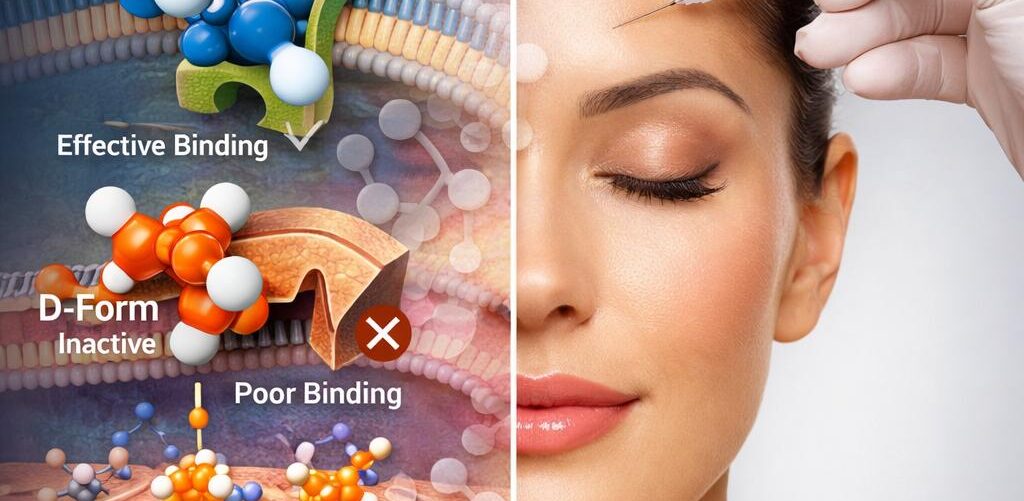
Human skin receptors are highly selective. They generally recognize and utilize only one enantiomer of a molecule. When the correct enantiomer binds to a receptor, it functions like a key fitting perfectly into a lock. When the incorrect form is present, the result can be reduced efficacy, irritation, or inflammatory responses.
Many conventional skincare products contain racemic mixtures, meaning a 50/50 blend of both left- and right-handed molecules. While one form may be active and beneficial, the other is often biologically inactive or even disruptive to the skin.
Chirally correct formulations, on the other hand, contain only the biologically active enantiomer. This precision dramatically improves how the skin responds to treatment.
Key Benefits of Chirally Correct Ingredients
1. Increased Efficacy and Absorption
Chirally corrected ingredients are purified to interact optimally with skin cell receptors. This leads to improved penetration, enhanced bioavailability, and stronger clinical results.
2. Reduced Irritation and Inflammation
The removal of the “wrong-handed” isomer minimizes unnecessary stress on the skin. This significantly reduces redness, dryness, sensitivity, and post-treatment
inflammation, especially important in medical aesthetics.
3. Improved Skin Rejuvenation
Chirally correct formulations are widely used in advanced cosmeceutical for anti-aging, antioxidant protection, collagen stimulation, and cellular renewal.
Examples of Chiral Ingredients in Advanced Skincare L-Ascorbic Acid (Vitamin C)
The L-form is the only biologically active form responsible for collagen stimulation, brightening, and antioxidant protection. The D-form is unstable and often irritating.
D-Alpha-Tocopherol (Vitamin E)
This is the natural, chirally correct form of vitamin E. It is significantly more effective than synthetic DL-alpha-tocopherol, which contains inactive molecules.
L-Lactic Acid The L-isomer is better recognized by the skin, promoting exfoliation, hydration, and rejuvenation with minimal irritation.
Why Chirally Correct Is Better Than “Natural” or Synthetic Alone?
While natural ingredients are often preferable, not all natural or synthetic products are inherently effective. The real issue lies in molecular recognition.
Synthetic ingredients frequently contain both D and L forms, even though the skin can only utilize one. For example:
Synthetic lactic acid contains both D and L molecules, but the skin only recognizes the L form.
Natural lactic acid contains exclusively the L form, making it far more effective and biologically compatible.
The same principle applies to vitamin E:
Natural vitamin E: D-alpha-tocopherol (fully active)
Synthetic vitamin E: DL-alpha-tocopherol (50% inactive or potentially irritating)
Artificial colors, fragrances, and flavors further increase biological stress because the body does not recognize them. Over time, these substances may accumulate in tissues or fat, contributing to inflammation, sensitivity, and long-term toxicity. Chirally correct formulations reduce this burden by delivering only what the skin can truly use.
How to Identify Chirally Correct Ingredients on Labels
Chirally correct ingredients are clearly identified on product labels by a D or L prefix before the ingredient name. These letters indicate the molecular orientation and help practitioners assess the quality and efficacy of a formulation.
Examples of Chirally Correct Ingredients:
L-Arbutin
Melanin inhibitor that reduces hyperpigmentation, melasma, and dark spots
L-Ascorbic Acid
Photoprotective, collagen-stimulating, and antioxidant
L-Lactic Acid
Enhances cellular metabolism, exfoliation, hydration, and barrier strength
L-Retinol A
Patented form offering retinoic acid benefits with minimal irritation
D-Alpha Tocopherol
Antioxidant that repairs and heals damaged tissue
D-Beta Fructan
Plant-derived ingredient supporting skin self-moisturization
D-Beta Glucosamine
Strengthens the skin barrier and enhances moisture retention.
Conclusion
Chirality represents a shift toward precision-based skincare, where effectiveness is determined not by quantity but by molecular compatibility. In medical aesthetics, chirally correct formulations ensure that the skin receives only biologically active ingredients, eliminating unnecessary irritation and maximizing therapeutic outcomes.
By understanding and applying chirality, practitioners elevate skincare from cosmetic enhancement to true skin health optimization. Chirally correct technology is not merely an innovation, it is the future of intelligent, science-driven medical aesthetics.
 Vancoderm Academy and College