
 Vancodermadmin
Scalp Rosacea
 Faramarz Rafie MD / Vancoderm Academy and College (VDA) / Vancoderm Clinic (VDCMed)
Definition:
Scalp rosacea is a chronic, relapsing inflammatory dermatosis involving the scalp skin, characterized by persistent centroperipheral erythema, neurovascular dysregulation, and perifollicular inflammation affecting the pilosebaceous units and superficial cutaneous vasculature. It represents either an extension of classical facial rosacea or, less commonly, a localized variant with predominant scalp involvement.
From a dermato-pathophysiologic perspective, scalp rosacea is mediated by:
- Dysregulation of innate immune responses, including overexpression of cathelicidin (LL-37) peptides
- Upregulation of pro-inflammatory cytokines (IL-1β, TNF-α)
- Increased matrix metalloproteinase activity
- Neurogenic inflammation driven by transient receptor potential (TRP) channels
- Vascular hyperreactivity and endothelial dysfunction
- Follicular colonization by Demodex species contributing to immune activation
- Histologically, findings may include:
- Superficial perivascular and perifollicular lymphohistiocytic infiltrates
- Telangiectasia and vascular dilation
- Mild perifollicular fibrosis in chronic cases
- Absence of the pronounced psoriasiform hyperplasia seen in psoriasis
Clinically, scalp rosacea presents with diffuse or patchy erythema, burning dysesthesia, follicular papules and pustules, and heightened cutaneous sensitivity. Unlike seborrheic dermatitis, scaling is typically minimal and greasy desquamation is not a dominant feature.
Scalp rosacea is best conceptualized as a disorder of cutaneous neurovascular instability and immune dysregulation involving the scalp’s pilosebaceous apparatus, with episodic exacerbations triggered by thermal, emotional, chemical, or ultraviolet stimuli.
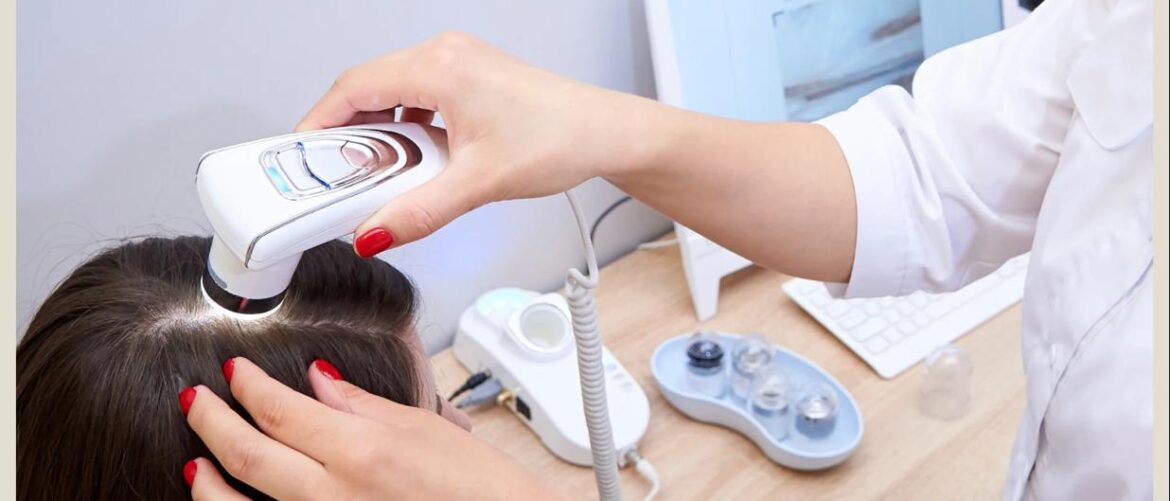
For academic and clinical training purposes, it should be differentiated from inflammatory scalp disorders such as seborrheic dermatitis, psoriasis, lupus erythematosus, and primary cicatricial alopecias through careful clinical evaluation and, where indicated, trichoscopy and histopathologic correlation.
Etiology of Scalp Rosacea
The etiology of scalp rosacea is multifactorial and involves a complex interplay between genetic susceptibility, innate immune dysregulation, neurovascular instability, microbial factors, and environmental triggers. Although the exact initiating event remains undefined, current evidence supports that rosacea is fundamentally a disorder of aberrant innate immune activation and cutaneous vascular hyperreactivity affecting the pilosebaceous unit.
At the molecular level, individuals with rosacea demonstrate upregulation of Toll-like receptor 2 (TLR-2) expression in keratinocytes. This heightened TLR-2 activity leads to increased production and abnormal processing of the antimicrobial peptide cathelicidin into its active form (LL-37), which exhibits pro-inflammatory, angiogenic, and vasodilatory properties. LL-37 promotes leukocyte chemotaxis, endothelial proliferation, and release of cytokines such as interleukin-8 (IL-8) and tumor necrosis factor-alpha (TNF-α), amplifying cutaneous inflammation. Matrix metalloproteinases (particularly MMP-9) are also upregulated, contributing to extracellular matrix degradation and vascular remodeling.
Neurovascular dysregulation plays a central role. Activation of transient receptor potential (TRP) channels—particularly TRPV1 and TRPA1—on sensory nerve fibers increases responsiveness to heat, capsaicin, ultraviolet radiation, and emotional stress. This stimulation results in neuropeptide release (e.g., substance P and calcitonin gene-related peptide), leading to vasodilation, plasma extravasation, and neurogenic inflammation. The scalp, with its rich vascular network and dense innervation, is particularly susceptible to this mechanism.
Microbial factors are implicated as secondary amplifiers rather than primary causes. Overproliferation of Demodex folliculorum within hair follicles may stimulate inflammatory cascades via bacterial antigens and associated Bacillus species, further activating TLR pathways. Additionally, alterations in the cutaneous microbiome may contribute to barrier dysfunction and immune activation.
Genetic predisposition has been suggested through familial clustering and associations with polymorphisms in genes regulating inflammatory and vascular responses. Individuals with fair skin phototypes (Fitzpatrick I–II) appear more susceptible, likely due to reduced photoprotective melanin and increased UV-mediated vascular damage.
Environmental and lifestyle triggers exacerbate the underlying pathophysiology. Ultraviolet radiation induces reactive oxygen species formation, promotes vascular endothelial growth factor (VEGF) expression, and worsens vasodilation. Thermal exposure, hot water, heat styling tools, occlusive hair products, chemical hair treatments, alcohol consumption, and emotional stress can precipitate flares by stimulating neurovascular pathways.
 Vancoderm Academy and College [VDA],