
 Vancodermadmin
Radiofrequency in Medical Aesthetics: Mechanisms, Benefits & Safety
Vancoderm Academy and College | Scientific Education Series

Faramarz Rafie MD / Vancoderm Academy and College [VDA] / Vancoderm Clinic [VDCmed]
Introduction
Radiofrequency technology has become an important component of modern medical aesthetics. It is used in skin tightening, facial rejuvenation, wrinkle reduction, body contouring, cellulite improvement, and acne-scar treatment. Unlike laser and intense pulsed light (IPL), which rely primarily on optical energy and selective absorption by tissue chromophores, radiofrequency devices deliver electrical energy into biological tissues.
The fundamental principle is the conversion of electrical energy into thermal energy within the tissue. This heating can initiate a series of biological responses, including collagen contraction, changes in the extracellular matrix, activation of wound-healing pathways, and longer-term collagen remodeling.
Understanding these mechanisms requires knowledge of electricity, molecular interactions, tissue composition, skin anatomy, and thermal physiology.
1. What Is Radiofrequency Energy?
Radiofrequency is a form of electromagnetic energy consisting of alternating electrical and magnetic fields. It occupies a portion of the electromagnetic spectrum between lower-frequency electrical signals and microwave radiation.
In medical aesthetic devices, RF energy is commonly delivered at frequencies ranging from hundreds of kilohertz to several megahertz, depending on the technology and device design.
Unlike laser energy, which is absorbed by specific chromophores such as melanin, hemoglobin, and water, conventional aesthetic RF energy does not depend on a specific optical chromophore.
Instead, RF energy interacts with the electrical properties of biological tissues.
The human body contains several components that influence RF energy distribution:
- Water, which is the major component of most soft tissues.
- Dissolved electrolytes, including sodium, potassium, chloride, and calcium ions.
- Proteins, including collagen, elastin, and structural proteins.
- Amino acids, which are the building blocks of proteins.
- Lipids, which form cell membranes and contribute to adipose tissue structure.
- Extracellular matrix components, including glycosaminoglycans and proteoglycans.
These components collectively determine the electrical conductivity, dielectric properties, and thermal response of the tissue.
2. What Happens at the Molecular Level When RF Energy Enters the Skin?
One of the most important concepts in understanding radiofrequency technology is that RF energy does not simply vibrate collagen molecules or directly stimulate amino acids to produce new collagen. Instead, its primary effect is the generation of heat through interactions with electrically charged particles and the electrical properties of tissue.
A. Movement of ions and electrical resistance
Biological tissues contain water with dissolved electrolytes. These electrolytes separate into positively and negatively charged ions.
Examples include:
-
Sodium ions (Na+)
-
Potassium ions (K+)
-
Calcium ions (Ca2+)
-
Chloride ions (Cl−)
When an alternating electrical field is introduced into tissue, charged particles respond to the changing electrical field. Their movement and associated interactions with the surrounding tissue contribute to electrical energy dissipation. Because biological tissues have electrical resistance, part of the electrical energy is converted into thermal energy. This phenomenon is known as Joule heating or resistive heating. The resulting heat increases the temperature of the surrounding tissue.
B. What happens to water molecules?
Water is particularly important because it represents a substantial proportion of skin and other biological tissues. A water molecule has an uneven distribution of electrical charge. Oxygen carries a partial negative charge, while the hydrogen atoms carry partial positive charges. This makes water a polar molecule.
When exposed to an alternating electrical field, water molecules experience interactions with that field and their orientation can respond to it. However, it is important to understand that conventional aesthetic RF devices operating in the kilohertz-to-megahertz range do not work in the same way as microwave ovens.
At these frequencies, ionic conduction is generally a major contributor to tissue heating. Dielectric polarization and molecular relaxation may also contribute, depending on the frequency and tissue properties.
The energy dissipated through these processes ultimately produces heat.
C. What about amino acids and proteins?
Amino acids are the fundamental building blocks of proteins. Collagen, elastin, and other structural proteins are composed of long chains of amino acids. These proteins maintain the architecture, elasticity, and mechanical strength of the skin.
RF energy does not selectively target individual amino acids or directly cause them to vibrate in a way that produces collagen. Instead, when tissue temperature increases, the heat affects the molecular structure of proteins.
At sufficiently high temperatures, the weak interactions responsible for maintaining protein structure can be disrupted. In collagen, thermal exposure can affect the triple-helical structure and intermolecular bonds. This can cause partial denaturation, contraction, and changes in the organization of collagen fibers.
The degree of these changes depends on temperature, exposure duration, tissue hydration, and the specific RF delivery method. This is one of the fundamental mechanisms behind RF skin-tightening treatments.
3. How Does Electrical Energy Become Heat?
The main thermal mechanism in conventional RF treatment is resistive heating. When electrical current passes through tissue, electrical resistance causes energy to be dissipated as heat.
The amount of heating is influenced by several factors:
-
Electrical current intensity.
-
Tissue impedance.
-
Applied voltage.
-
Frequency.
-
Electrode configuration.
-
Treatment duration.
-
Tissue conductivity.
-
Contact between the electrode and skin.
The relationship between electrical power and resistance can be expressed as:
Where:
- P represents electrical power.
- I represents electrical current.
- R represents electrical resistance.
This relationship helps explain why current intensity and tissue impedance are important in determining energy deposition.
However, actual RF tissue heating is more complex because biological tissue is heterogeneous, its impedance changes during treatment, and the device may continuously adjust its electrical output.
An important clinical point: Higher displayed energy does not necessarily mean better treatment. Safe and effective RF treatment depends on controlled energy delivery and achieving an appropriate thermal response in the intended tissue.
4. How Does RF Energy Affect Different Skin Layers?
A. Epidermis
The epidermis is the outermost layer of the skin. It contains keratinocytes, melanocytes, and other specialized cells.
Its primary functions include:
-
Protecting the body from external environmental factors.
-
Maintaining the skin barrier.
-
Regulating water loss.
-
Providing protection against microorganisms.
RF treatments can heat the epidermis, depending on the electrode configuration and treatment technique. Some RF technologies are designed to protect the epidermis while delivering heat into deeper tissues. Others intentionally create controlled epidermal or superficial dermal heating. Appropriate cooling and contact management are particularly important when the epidermis is exposed to significant thermal energy.
B. Dermis
It contains:
-
Collagen fibers.
-
Elastin fibers.
-
Fibroblasts.
-
Blood vessels.
-
Nerve endings.
-
Hair follicles and sebaceous glands.
-
Extracellular matrix components.
-
Water and ground substances.
Collagen provides structural strength, while elastin contributes to elasticity. Fibroblasts are responsible for producing and maintaining collagen, elastin, and other extracellular matrix components. When RF energy produces controlled thermal stimulation in the dermis, several biological responses can occur.
Immediate response: collagen contraction
Thermal exposure can alter collagen’s molecular structure, resulting in contraction and changes in fiber organization.
This may produce an immediate tightening effect, although the visible clinical result varies between patients and treatment technologies.
Delayed response: wound-healing and remodeling
Controlled thermal stimulation can initiate biological repair processes.
These may include:
-
Activation of fibroblasts.
-
Changes in cellular signaling.
-
Production of new collagen.
-
Remodeling of existing extracellular matrix.
-
Changes in tissue organization and mechanical properties.
These processes develop over weeks and months rather than immediately after treatment.
C. Hypodermis and subcutaneous adipose tissue
Certain RF technologies are designed to deliver energy into deeper tissue regions for body contouring or localized fat reduction.
Thermal exposure may influence adipose tissue, depending on the device, energy delivery system, and treatment protocol.
However, not all RF devices produce fat reduction. Some are designed primarily for superficial skin rejuvenation, while others target deeper connective tissue or adipose compartments.
Understanding the intended treatment depth is essential when selecting an RF technology.
5. How Does RF Stimulate Collagen Production?
Collagen is one of the most important structural proteins in the skin. Type I collagen is the predominant dermal collagen, while Type III collagen also plays an important role in dermal structure and tissue repair.
As skin ages, collagen production and organization change. Collagen degradation increases, while the structural support of the dermis gradually decreases. RF-induced thermal stimulation can initiate a controlled tissue response.
The process can be understood in several stages.
Stage 1: Thermal stimulation
RF energy produces heat in the targeted tissue.
Stage 2: Changes in collagen structure
Depending on the temperature and exposure duration, collagen fibers may undergo partial thermal denaturation and contraction.
Stage 3: Biological repair response
The body initiates repair mechanisms involving inflammatory signaling, cellular activity, and tissue remodeling.
Stage 4: Fibroblast activity
Fibroblasts participate in the production and organization of new extracellular matrix components.
Stage 5: Collagen remodeling
Over time, collagen deposition and reorganization can contribute to improvements in skin firmness, texture, and structural support.
It is important to distinguish between immediate collagen contraction and delayed neocollagenesis. They are related but different processes.
6. Different Types of Radiofrequency Technologies in Medical Aesthetics
Not all RF devices deliver energy in the same way. Their clinical effects depend on electrode design, frequency, electrical configuration, energy delivery, and treatment depth.
1. Electrical configurations
-
Monopolar RF
-
Unipolar RF (where technically distinguished)
-
Bipolar RF
-
Multipolar RF (Triploar)
2. Energy-delivery techniques
-
Conventional (non-fractional) RF
-
Fractional RF
-
RF microneedling
Monopolar RF and Unipolar
Monopolar RF typically uses an active treatment electrode and a separate return electrode, often a grounding or dispersive pad. The electrical circuit passes through tissue between these electrodes. Depending on the device design, monopolar RF can deliver energy to relatively deep tissue regions.
Unipolar:
Unipolar: Refers to a single-pole electrode configuration without a grounding pad.
Applications may include:
-
Skin tightening.
-
Facial rejuvenation.
-
Body contouring.
-
Improvement in skin laxity.
Bipolar RF
Bipolar RF uses two electrodes, with electrical current flowing through tissue between them. The energy distribution is influenced by the distance between electrodes, electrode geometry, contact, and tissue electrical properties. Bipolar RF is commonly used for localized skin tightening and rejuvenation.
Multipolar RF (Tripolar)
Multipolar RF uses multiple electrodes to deliver electrical energy through different electrode combinations. The objective is to distribute energy across a treatment area while controlling the heating pattern. Depending on the system, multipolar technologies may be used for facial treatments, skin tightening, and body applications.
Fractional RF
Fractional RF delivers energy through multiple separated treatment points, creating controlled zones of thermal stimulation. The fractional approach means that only selected portions of the treatment area receive concentrated energy, while intervening tissue remains relatively untreated. This allows the surrounding tissue to contribute to the healing process.
It is important to distinguish fractional RF from RF microneedling.
-
Non-invasive fractional RF: Delivers energy through surface electrodes without penetrating needles.
-
RF microneedling: Uses needles or electrode-bearing microneedles to deliver RF energy at selected depths within the skin.
These technologies have different mechanisms of energy delivery, tissue effects, treatment risks, and clinical indications.
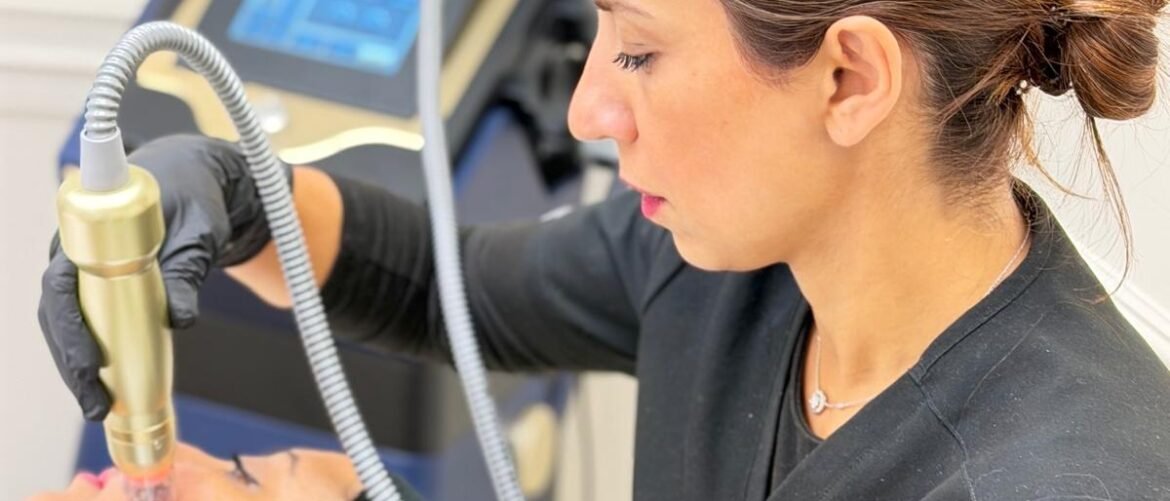
 RF microneedling
Depending on the device, the energy can be delivered through:
-
Monopolar needle configurations.
-
Bipolar needle configurations.
-
Insulated needles.
-
Non-insulated needles.
The objective is to produce controlled thermal zones in the dermis or other intended tissue layers while limiting unnecessary injury to surrounding structures. Clinical applications may include acne scarring, skin texture improvement, wrinkles, and selected skin-tightening indications.
Because this technique involves skin penetration, infection control, depth selection, needle configuration, and patient assessment are particularly important.
7. What Determines the Final Clinical Result?
Successful RF treatment is not simply a matter of selecting a device and increasing its energy level.
Several factors determine the treatment outcome.
| Factor | Importance |
|---|---|
| Frequency | Influences electrical interaction with tissue |
| Power and energy | Influence the rate and amount of energy delivered |
| Impedance | Affects current distribution and energy deposition |
| Electrode configuration | Influences the electrical field and heating pattern |
| Treatment duration | Influences cumulative thermal exposure |
| Tissue hydration | Influences electrical and thermal properties |
| Contact and pressure | Influence energy coupling and distribution |
| Treatment depth | Determines which structures receive thermal stimulation |
| Cooling | Helps control unwanted surface heating |
| Tissue temperature | Influences biological response and potential injury |
Temperature and exposure time must be considered together. A particular temperature maintained for a longer period may produce a different biological effect than the same temperature applied briefly.
For this reason, treatment protocols should be based on the specific device’s validated instructions rather than assuming that one temperature or energy setting is appropriate for all RF technologies.
8. Safety Precautions and Proper Use of RF Devices
A. Patient assessment before treatment
Before beginning treatment, the practitioner should:
-
Review the patient’s medical history.
-
Identify contraindications and precautions specified by the manufacturer.
-
Assess skin condition and treatment area.
-
Identify active infections, open wounds, and inflammation.
-
Evaluate skin sensitivity and previous treatment history.
-
Assess the presence of implanted electronic devices or metal implants where relevant to the device.
-
Explain expected results, limitations, and potential adverse effects.
-
Obtain informed consent.
Contraindications differ between RF technologies. For example, precautions for non-invasive monopolar RF may not be identical to those for RF microneedling.
B. Proper electrode contact
For devices requiring direct skin contact, proper contact is essential. Poor contact, inadequate coupling, inappropriate pressure, or uneven movement may result in localized heating.
Depending on the system, this may increase the risk of:
-
Hot spots.
-
Pain.
-
Burns.
-
Blistering.
-
Uneven treatment effects.
Always follow the manufacturer’s recommendations for coupling media, electrode positioning, pressure, and movement.
C. Energy selection and temperature monitoring
One of the most common mistakes in RF treatment is assuming that higher energy produces better results. Excessive energy or prolonged exposure may cause unwanted tissue injury.
Practitioners should:
-
Begin with the manufacturer’s recommended settings.
-
Follow device-specific treatment protocols.
-
Monitor patient comfort and tissue response.
-
Use integrated temperature monitoring when provided.
-
Avoid unnecessary repeated passes.
-
Allow appropriate cooling between treatment areas when required.
Patient comfort alone is not a reliable measurement of tissue temperature or treatment safety.
D. Cooling systems
Some RF devices incorporate cooling technologies to protect the epidermis or improve treatment comfort. Cooling may be delivered through contact cooling, cryogenic systems, or other device-specific mechanisms. However, cooling does not eliminate the possibility of deeper thermal injury.
The practitioner must understand which tissue layers are being heated and which are being protected.
E. Hygiene and infection control
For non-invasive RF, proper cleaning and disinfection of treatment surfaces and handpieces are essential.
For RF microneedling, additional precautions are required:
-
Use sterile, single-use needle cartridges as specified by the manufacturer.
-
Follow appropriate hand hygiene and PPE protocols.
-
Prepare the treatment area according to infection-control standards.
-
Never reuse disposable needle cartridges.
-
Follow proper sharps disposal procedures.
-
Maintain appropriate post-treatment wound-care instructions.
F. Recognition of adverse effects
Possible adverse effects include:
-
Temporary redness.
-
Swelling.
-
Tenderness.
-
Transient sensitivity.
-
Burns and blistering.
-
Post-inflammatory hyperpigmentation.
-
Scarring.
-
Unwanted fat atrophy or contour changes in certain deep-heating applications.
-
Nerve injury in uncommon cases, depending on the technology and treatment location.
Persistent pain, blistering, significant swelling, altered sensation, or other unexpected tissue changes require prompt assessment and appropriate medical management.
9. Why Professional Knowledge Matters
Operating an RF machine is not the same as understanding radiofrequency treatment. A qualified practitioner must understand the relationship between electrical energy, tissue impedance, thermal distribution, skin anatomy, and biological response.
For example, two devices may both be described as bipolar RF, but their electrode arrangements, energy delivery, treatment depth, and thermal profiles may be significantly different.
Similarly, a fractional RF resurfacing device and an RF microneedling device should never be considered interchangeable simply because both use radiofrequency energy.
Proper education helps practitioners understand:
-
How RF energy interacts with biological tissue.
-
Why heat is generated.
-
How collagen responds to thermal exposure.
-
Why different technologies have different clinical applications.
-
How treatment parameters influence safety and effectiveness.
-
How to recognize inappropriate tissue responses.
-
How to select suitable treatment protocols.

At Vancoderm Academy and College, understanding the scientific principles behind aesthetic equipment is an essential part of professional education. Students should learn not only how to operate equipment, but also why particular technologies and treatment parameters are selected.
Conclusion
Radiofrequency technology is based on the conversion of electrical energy into thermal energy within biological tissues. Through interactions with charged particles and the electrical properties of tissue, RF energy produces heat that can influence collagen structure, fibroblast activity, extracellular matrix organization, and tissue remodeling.
Its effectiveness depends on controlled energy delivery, appropriate treatment depth, tissue response, and the correct selection of technology.
The most important principle in RF practice is that the goal is not to generate the maximum amount of heat, but to achieve a controlled and appropriate thermal response in the intended tissue while protecting surrounding structures.
Scientific knowledge, practical training, patient assessment, and proper equipment operation are essential for achieving safe and consistent clinical outcomes.
Suggested scientific references
For a medically oriented publication, I recommend consulting:
1. Fundamental mechanisms of radiofrequency and tissue heating
These are particularly important for explaining how electrical energy interacts with tissue, produces heat, and differs from laser energy.
1. Noninvasive radio frequency for skin tightening and body contouring
-
Author: Robert A. Weiss
-
Journal: Seminars in Cutaneous Medicine and Surgery, 2013.
-
PMID: 24049924.
2. Introduction and overview of radiofrequency treatments in aesthetic dermatology
-
Journal: Journal of Cosmetic Dermatology, 2022.
-
PMID: 36459080.
-
DOI: 10.1111/jocd.15026.
An excellent general reference covering:
-
Monopolar, bipolar and multipolar RF.
-
Different methods of energy delivery.
-
Tissue penetration and energy distribution.
-
Skin and adipose tissue remodeling.
-
Safety considerations and treatment endpoints.
2. Collagen, fibroblasts and skin remodeling
These articles are especially useful for explaining what happens after thermal stimulation.
3. Histologic study of collagen and stem cells after radiofrequency treatment for aging skin
-
Authors: Yokoyama Y et al.
-
Journal: Dermatologic Surgery, 2014.
-
PMID: 24460747.
-
DOI: 10.1111/dsu.12443.
This is particularly valuable because it investigates histological changes following RF treatment rather than relying exclusively on clinical photographs.
4. Radiofrequency therapy in esthetic dermatology: A review of clinical evidences
-
Journal: Journal of Cosmetic Dermatology, 2020.
-
PMID: 31691477.
-
DOI: 10.1111/jocd.13206.
Useful for explaining collagen denaturation, subsequent collagen formation, skin tightening, and clinical evidence.
5. Radiofrequency facial rejuvenation: Evidence-based effect
-
PMID: 21315951.
-
DOI: 10.1016/j.jaad.2010.06.045.
An important study investigating changes in collagen types I and III and newly synthesized collagen after RF treatment.
6. Monopolar radiofrequency treatment for facial laxity: Histometric analysis
-
Journal: Journal of Cosmetic Dermatology, 2020.
-
PMID: 32319176.
-
DOI: 10.1111/jocd.13449.
Useful for the relationship between monopolar RF, dermal structure, and skin laxity.
3. Different RF technologies and clinical applications
7. Evaluation of the clinical efficacy of fractional radiofrequency microneedle treatment in acne scars and large facial pores
-
Journal: Dermatologic Surgery, 2012.
-
PMID: 22487513.
-
DOI: 10.1111/j.1524-4725.2012.02402.x.
Particularly useful for explaining bipolar RF delivery through microneedle electrodes and dermal matrix regeneration.
8. Comparison of fractional microneedling radiofrequency and bipolar radiofrequency on acne and acne scar and investigation of mechanism
-
Journal: Archives of Dermatological Research, 2015.
-
PMID: 26472097.
This is a valuable reference because it compares two RF technologies and investigates molecular changes, including TGF-β, collagen I, NF-κB, and IL-8.
9. Efficacy and safety of fractional microneedle radiofrequency for atrophic acne scars: A real-world clinical study of 126 patients
-
Journal: Lasers in Surgery and Medicine, 2024.
-
PMID: 38282120.
-
DOI: 10.1002/lsm.23759.
Useful for discussing treatment parameters, clinical effectiveness, and adverse effects.
4. Safety and clinical evidence
10. Evaluating the effectiveness and safety of radiofrequency for face and neck rejuvenation: A systematic review
– PMID: 34923652.
A particularly useful reference for evaluating clinical outcomes, adverse effects, and tissue remodeling.
11. Safety and efficacy of fractional radiofrequency for the treatment and reduction of acne scarring: A prospective study
-
Journal: Lasers in Surgery and Medicine, 2022.
-
PMID: 34412150.
-
DOI: 10.1002/lsm.23453.
Useful for the safety and effectiveness section.
12. Radiofrequency-Based Treatments for Facial Rejuvenation: A Systematic Review of Efficacy, Safety, and Patient-Centered Outcomes
-
Journal: Aesthetic Surgery Journal Open Forum, 2025.
-
PMID: 41426292.
A recent systematic review covering effectiveness, patient satisfaction, tolerability, and adverse effects.