
 Vancodermadmin
Adverse Effects in Medical Aesthetics: Causes and Prevention
Faramarz Rafie MD / Vancoderm Academy and College [VDA] / Vancoderm Clinic [VDCmed]
Vancoderm Academy and College | Weekly Clinical Education
Medical aesthetics involves the application of energy, mechanical stimulation, chemical agents, and other interventions to living tissue. The objective of treatment is to produce a controlled biological response that improves a specific cosmetic or dermatological concern while minimizing injury to surrounding tissue.
However, not every patient responds in the same way.
An identical procedure performed with the same technology can produce an appropriate response in one patient and an unexpected or adverse response in another. Understanding this difference is fundamental to safe medical aesthetic practice.
Adverse effects are rarely explained by a single variable. Patient characteristics, clinical assessment, practitioner knowledge, treatment parameters, device performance, treatment technique, and aftercare can all influence the final outcome.
For this reason, medical aesthetic professionals must learn to look beyond the machine and understand the biological and clinical factors that determine treatment response.
What Is an Adverse Effect?
Every Medical aesthetic procedure produces some degree of biological change. Some changes are expected and temporary. For example, mild erythema, edema, warmth, or sensitivity may occur following certain laser, light, Radiofrequency, Microneedling, or chemical treatments.
An adverse effect is different. It represents an unwanted or excessive response that may result in tissue injury, prolonged inflammation, infection, pigmentary alteration, scarring, or another complication.
The distinction between an expected treatment response and an adverse event requires knowledge of the procedure, the technology, the patient’s skin, and the expected healing process.
A practitioner should therefore never assess a treatment response based only on whether redness or swelling is present. The intensity, duration, distribution, associated symptoms, and progression of the response must also be considered.
Patient Factors
The first consideration is the patient. Skin is biologically variable tissue. Patients differ in pigmentation, vascularity, barrier function, inflammatory response, wound-healing capacity, sensitivity, and susceptibility to pigmentary changes.
These differences can significantly influence the response to treatment.
Skin pigmentation
Pigmentation is particularly important when using optical technologies. Medical cosmetic Laser and light-based treatments rely on the interaction between specific wavelengths of energy and tissue chromophores. Melanin can absorb optical energy, and the amount and distribution of epidermal melanin can influence the amount of energy absorbed by the surrounding skin.
This is one reason why treatment parameters cannot simply be transferred from one patient to another.
Patients with greater epidermal pigmentation may have a different risk profile for certain light-based procedures, particularly when inappropriate parameters, inadequate cooling, or inappropriate treatment selection are involved.
The practitioner must understand the relationship between wavelength, fluence, pulse duration, spot size, cooling, chromophore absorption, and tissue response.
The condition of the skin
The skin should be assessed immediately before treatment. A patient may have undergone an appropriate consultation several weeks earlier but present with a different skin condition on the day of treatment. Treatment may need to be postponed when there is active infection, significant inflammation, compromised barrier function, open wounds, active dermatitis, recent excessive sun exposure, recent tanning, or another unexplained skin change. Treating compromised skin can increase irritation and interfere with normal recovery.
A pre-treatment assessment is therefore not simply an administrative requirement. It is a clinical safety measure.
Medication and Product History
Medication history is another important component of patient assessment. Certain medications can affect photosensitivity, inflammation, bleeding, immune response, wound healing, or skin integrity. Topical products may also affect the epidermal barrier and alter tolerance to treatment.
Aesthetic professionals should obtain an appropriate medication and skincare history and recognize situations that require modification, postponement, or medical consultation.
Prescribed medications should never be discontinued solely on the recommendation of an medical aesthetic practitioner unless this is within an appropriate medical relationship and scope of practice.
When there is uncertainty, communication with the patient’s prescribing healthcare professional may be necessary.
Previous Procedures
Previous cosmetic and dermatological procedures can also influence treatment response.
Recent laser procedures, chemical peels, Microneedling, injectables, surgery, or other interventions may temporarily alter the skin barrier, inflammatory response, or tissue structure.
Patients may not always consider these procedures relevant when completing a consultation form.
The practitioner must therefore ask specific questions rather than relying exclusively on the patient’s interpretation of what is medically relevant.
Patient Expectations
Patient expectations are also clinically important. A patient may request increasingly aggressive treatment because they believe that a stronger treatment will produce faster or better results.
This is not necessarily true. The objective of a medical aesthetic procedure is not to maximize treatment intensity. The objective is to produce the appropriate biological response while maintaining an acceptable safety margin.
A responsible practitioner must communicate realistic expectations and explain that some treatments require multiple sessions, gradual improvement, or a period of biological remodeling.
Practitioner Factors
The second major factor is the practitioner. Aesthetic devices have become increasingly sophisticated, but technology does not replace clinical knowledge. A practitioner should understand the relevant anatomy, physiology, skin pathology, device physics, indications, contraindications, expected treatment responses, potential complications, and appropriate referral pathways.
Operating a device is not the same as understanding the biological response produced by that device.
A practitioner who knows which button to press but does not understand tissue response may be unable to recognize when a treatment is becoming unsafe.
Clinical Assessment Before Treatment
A proper assessment should establish whether the patient is an appropriate candidate for the proposed procedure. The practitioner should consider the patient’s primary concern, treatment objective, relevant history, previous procedures, medications, current skin condition, risk factors, expectations, and available alternatives.
The practitioner must also consider whether the proposed treatment falls within their professional scope.
Knowing when not to treat is an important component of clinical competence.
Treatment Parameters
Treatment parameters are particularly important with energy-based procedures. Depending on the technology, parameters may include wavelength, fluence, pulse duration, spot size, frequency, treatment density, cooling, number of passes, treatment overlap, and other device-specific variables. These parameters influence the amount and distribution of energy delivered to tissue.
Increasing treatment intensity does not necessarily produce a proportionally greater clinical benefit. At a certain point, additional energy may increase tissue injury rather than improve the intended outcome.
The practitioner must therefore understand the therapeutic range of the procedure and the factors that influence tissue tolerance.
The Importance of Tissue Response
The patient’s tissue response provides important information during treatment.
The clinical practitioner specialist in medical aesthetics should know the expected clinical endpoint for the specific procedure and recognize responses that may indicate excessive tissue injury.
Depending on the procedure, an appropriate endpoint may involve controlled erythema, perifollicular edema, warmth, blanching, or another procedure-specific response.
These findings must always be interpreted in context.
A response that is appropriate for one technology may be inappropriate for another.
Clinical observation therefore remains essential even when a device has automated settings or predefined treatment protocols.
Device Factors
The device is another important part of patient safety. Aesthetic medicine equipment should be maintained, serviced, and operated according to applicable requirements and manufacturer instructions.
Potential device-related factors include equipment malfunction, incorrect handpiece selection, inappropriate settings, inadequate cooling, damaged components, maintenance problems, or operator error.
A sophisticated device does not eliminate clinical risk.
The practitioner must understand what the device is designed to do, its limitations, its appropriate indications, and the conditions under which treatment should be modified or stopped.
Why Machine Settings Alone Are Not Enough
One of the most important principles in medical aesthetics is that a treatment setting cannot be considered appropriate in isolation. The same numerical setting can produce different biological effects in different patients.
Skin pigmentation, hair characteristics, treatment area, tissue thickness, previous treatment, cooling, device characteristics, and individual biological variation can all influence the response.
Therefore, a machine setting should never replace patient assessment and clinical judgment.
Treatment Technique
Technique can also influence outcomes. Examples include treatment overlap, pressure, handpiece contact, movement speed, number of passes, treatment density, application technique, and consistency of delivery.
Even when the selected parameters are appropriate, poor technique can alter energy distribution and increase the risk of unintended tissue injury.
This is why practical training on real model is essential.
Students must learn not only what parameters are used, but how treatment is physically delivered and how the tissue responds during the procedure.
Aftercare and Patient Compliance
The treatment itself is only one component of the clinical process. Aftercare can influence recovery and the development of complications.
Patients should receive clear instructions regarding cleansing, skincare products, sun exposure, heat, exercise, manipulation of the treated area, and other relevant activities depending on the procedure.
Patients should also be informed about expected recovery and warning signs.
A patient who understands what is normal is more likely to recognize when something is abnormal and contact the clinic promptly.
Recognizing an Adverse Event
When an unexpected response occurs, the first responsibility is recognition. The practitioner should determine whether the response is consistent with the expected physiological reaction or whether it suggests a complication.
Potential warning signs include significant or worsening pain, excessive or persistent erythema, dusky or darkening erythema, extensive blistering, epidermal disruption or ulceration, progressive or disproportionate swelling, unexpected changes in skin color or texture, signs of infection, delayed wound healing, significant or persistent pigmentary changes, and ocular symptoms following procedures involving potential eye exposure.
The appropriate response depends on the procedure and the nature and severity of the event.
The practitioner may need to discontinue treatment, provide appropriate immediate care within their scope, document the event, notify the appropriate supervising or responsible healthcare professional, arrange medical assessment, or refer the patient for further evaluation.
Complications should never be minimized simply because they were unintended.
Documentation
Accurate documentation is an important component of patient safety.
A treatment record should contain sufficient information to allow another qualified professional to understand what was assessed and what was performed.
Depending on the procedure, documentation may include the patient’s relevant history, assessment findings, informed consent, treatment indication, device and applicator, treatment parameters, technique, observed tissue response, aftercare instructions, follow-up recommendations, and any adverse event.
Good documentation also supports learning.
When an unexpected outcome occurs, the treatment record can help the clinical team determine whether there were identifiable contributing factors and how future treatment should be modified.
Prevention Through Clinical Decision-Making
Prevention is more effective when it is incorporated into every stage of treatment.
The Clinical practitioner should assess the patient before treatment, confirm that the procedure is appropriate, select the appropriate technology, establish suitable treatment parameters, monitor tissue response, provide appropriate aftercare, and arrange follow-up when indicated.
This process requires clinical reasoning. A protocol provides structure, but clinical judgment determines whether that protocol is appropriate for the individual patient.
Vancoderm Academy and College: Training for Clinical Competence
At Vancoderm Academy and College, our approach to education should reflect the medical nature of aesthetic practice.
Students should not be trained simply to operate machines.
They should be trained to understand the relationship between the patient, the skin, the technology, the treatment parameters, and the biological and physiological response.
Our educational strategy emphasizes several areas.
Anatomy and Physiology
Students need a strong understanding of skin anatomy, physiology, pigmentation, vascular structures, hair follicles, inflammatory processes, and wound healing.
Without this foundation, it is difficult to understand why a particular treatment works or why an adverse response occurs.
Dermatological Assessment
Students should develop the ability to assess skin before treatment and recognize findings that may require treatment modification, postponement, or referral.
They should understand the difference between normal skin variation and findings that may indicate underlying pathology.
Technology and Tissue Interaction
Students should learn how laser, light, radiofrequency, ultrasound, Microneedling, chemical agents, and other technologies interact with tissue within the scope of their education and practice.
The emphasis should be on understanding mechanisms rather than memorizing machine settings.
Evidence-Informed Practice
Students should be taught to critically evaluate treatment protocols and understand that manufacturer recommendations, clinical evidence, professional standards, and applicable regulations all contribute to responsible practice.
Supervised Clinical Training
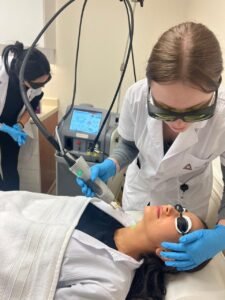
Hands-on training should take place under appropriate supervision while Medical Aesthetics Diploma students work on real models in a controlled clinical learning environment.
Students need opportunities to develop patient assessment skills, professional communication, treatment technique, tissue observation, documentation, and clinical judgment while gaining practical experience with real-world patient responses.
Complication Recognition
Complication management should be part of the curriculum. Medical Aesthetics Diploma Students should understand potential adverse effects associated with the procedures they are learning and recognize when an unexpected response requires escalation or referral.
The purpose is not to create fear around aesthetic medicine.
The purpose is to develop practitioners who can recognize risk and respond appropriately.
Professional Scope and Referral
Students should understand the boundaries of their education, professional role, and jurisdictional scope of practice. A competent clinical practitioner specialist in Medical Aesthetics does not attempt to manage every clinical problem independently. Knowing when to refer is a fundamental component of patient safety.
 The Vancoderm Academy and College Philosophy
Medical aesthetics is not simply about producing visible change. It is about producing an appropriate biological response in an appropriately selected patient while minimizing preventable harm.
The quality of a medical aesthetic practitioner should therefore not be measured only by how well they can operate a device.
It should also be measured by how well they assess patients, understand tissue biology, recognize risk, select appropriate treatments, monitor responses, document care, recognize complications, and know when medical referral is necessary.
At Vancoderm Academy and College, our objective is to develop practitioners who understand both the science and the responsibility behind medical aesthetic treatment.
The central question should not be how aggressively a treatment can be performed.
The central question should be whether the treatment is appropriate for the individual patient, whether the expected biological response is understood, and whether the clinical practitioner is prepared to recognize and manage an unexpected outcome.
That is the foundation of patient-centered medical aesthetics.
Vancoderm Academy and College
Clinical knowledge. Evidence-informed practice. Patient safety.
“This article is intended for professional education and does not replace medical assessment, device-specific training, manufacturer instructions, applicable legislation, institutional policies, or the advice of an appropriately qualified healthcare professional. Scope of practice varies by jurisdiction and procedure.”