
 Vancodermadmin
Needle-Based and Needle-Free Delivery Systems in Medical Aesthetics: Mechanisms, Applications, and Emerging Technologies
 Faramarz Rafie MD / Vancoderm Academy and College (VDA) / Vancoderm Clinic (VDCmed)
Introduction
The skin is one of the body’s most important biological barriers. Its outermost layer, the stratum corneum, protects the body from environmental exposure while simultaneously limiting the penetration of many therapeutic and cosmetic substances. For this reason, modern medical aesthetics and dermatological medicine have increasingly explored different methods of delivering active ingredients beyond the superficial skin surface. These approaches can broadly be divided into needle-based delivery systems and needle-free or non-needle-based delivery systems. Although both approaches aim to improve the delivery of selected substances into or through the skin, they differ substantially in their mechanisms, depth of delivery, degree of tissue disruption, clinical indications, and safety considerations.
What Is a Skin Delivery System?
A skin delivery system is a method or technology designed to transport a substance through, into, or across the skin to achieve a localized or systemic biological effect. Depending on the technology, the target may be the epidermis, dermis, subcutaneous tissue, or systemic circulation. Conventional topical application relies primarily on passive diffusion, but the natural barrier function of the stratum corneum can substantially restrict penetration. Modern delivery technologies therefore attempt to overcome this barrier through mechanical, chemical, electrical, acoustic, thermal, or other physical mechanisms. Recent research continues to focus on improving delivery efficiency while maintaining safety, consistency, and patient comfort.
Needle-Based Delivery Systems
Needle-based delivery refers to techniques in which a needle or microneedle is used to create a pathway through the skin or to place an approved substance directly into a selected tissue compartment. Conventional injections can provide highly localized delivery because the substance is physically deposited beneath the epidermal barrier. In medical aesthetics, needle-based approaches may be used for appropriately indicated injectable treatments, localized therapies, and certain procedures designed to stimulate controlled tissue responses.
An important distinction is that not all needle-based systems have the same depth, mechanism, or clinical purpose. Conventional needles can reach deeper tissues, whereas microneedles are designed with microscopic projections that interact with the skin barrier while minimizing the depth and tissue disruption associated with conventional needles. Microneedle technologies have become an important area of research for transdermal drug delivery, sensing, vaccination, and localized therapy.
Microneedles: A Bridge Between Conventional Injection and Transdermal Delivery
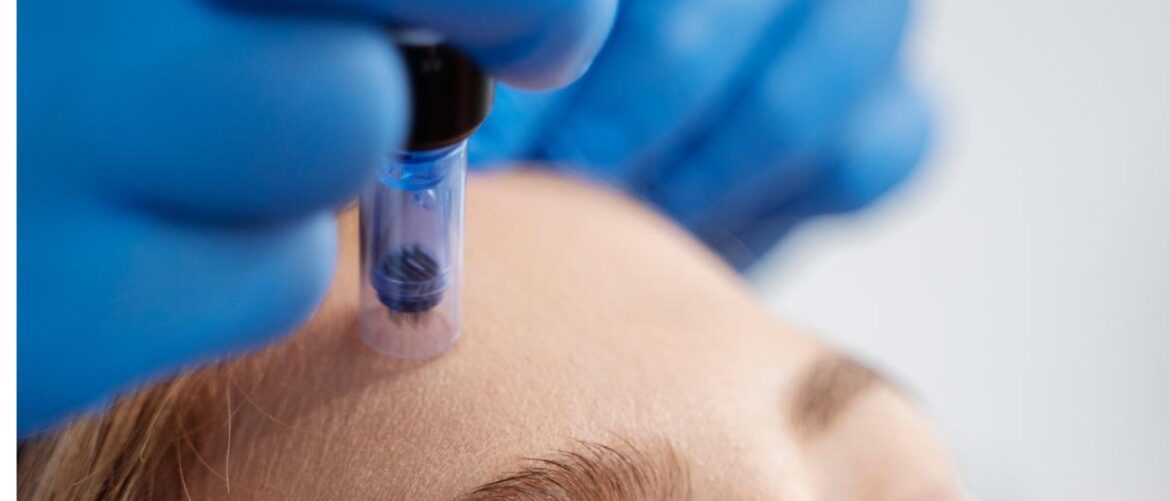
Microneedles represent one of the most rapidly developing areas of modern skin-delivery research. Rather than relying on a conventional hypodermic needle, microneedle systems use microscopic structures to create temporary pathways through the stratum corneum. Depending on their design, these systems may be solid, coated, hollow, dissolving, or hydrogel-forming.
The fundamental mechanism is relatively straightforward: the microneedle structure temporarily alters the skin barrier, creating microscopic pathways through which selected molecules can be delivered. Some newer designs incorporate materials that dissolve or swell after contacting biological fluids, allowing controlled release of their payload. Research published in 2025 and 2026 has increasingly focused on intelligent microneedle systems capable of controlled, responsive, and potentially personalized delivery.
Needle-Free and Non-Needle-Based Delivery Systems
Needle-free delivery systems attempt to improve penetration or transport without using conventional needles. These technologies can use physical energy, pressure, electrical fields, acoustic energy, laser-generated effects, or specialized formulations to temporarily modify the skin barrier.
The term needle-free, however, should not automatically be interpreted as meaning completely risk-free or suitable for every patient. Different technologies produce different biological effects, and some can still cause irritation, inflammation, thermal effects, or other adverse responses. Appropriate patient selection, device-specific training, approved products, and professional oversight remain essential.
Major Types of Needle-Free Delivery Technologies
Iontophoresis
Iontophoresis uses a controlled electrical current to facilitate the movement of suitable molecules across the skin. The electrical field can influence the movement of charged substances and can increase their transport through the skin barrier. Its effectiveness depends on factors such as molecular charge, formulation, skin characteristics, and the electrical characteristics of the system.
In principle, iontophoresis is particularly relevant when the substance being delivered has physicochemical characteristics compatible with electrically assisted transport. Research has investigated its potential for localized and systemic delivery, including larger therapeutic molecules.
Sonophoresis
Sonophoresis, sometimes called phonophoresis, uses ultrasound energy to temporarily increase skin permeability. Acoustic energy can influence the structure and behavior of the skin barrier and facilitate molecular transport.
Recent research describes cavitation and mechanical effects as important contributors to sonophoretic enhancement. Unlike electrically driven approaches, sonophoresis is not inherently limited to charged molecules, which gives it a different potential application profile.
Electroporation
Electroporation uses short electrical pulses to temporarily alter cellular or tissue permeability. The principle is based on transient changes in biological membranes that can facilitate the movement of substances that would otherwise have difficulty crossing the skin barrier.
Electroporation remains an important research area in transdermal and biomedical delivery, particularly for molecules whose size or characteristics make passive diffusion difficult.
Needle-Free Jet Delivery
Needle-free jet systems use a high-velocity stream of liquid to deliver a substance through the skin without a conventional needle. The mechanical force of the jet creates a pathway through the skin barrier.
Modern research has examined different activation mechanisms, including spring-driven, gas-driven, piezoelectric, electromagnetic, and other systems. The technology continues to evolve toward greater control of delivery depth, volume, consistency, and patient comfort.
Laser-Assisted and Energy-Assisted Delivery
Certain energy-based technologies can temporarily modify the skin barrier or create microscopic pathways that facilitate delivery. Laser-assisted approaches have been investigated as physical methods for enhancing transdermal transport.
These systems demonstrate an important principle in modern aesthetic medicine: energy is not necessarily being used only to treat the target tissue directly; it can also be used to modify the permeability or architecture of the skin so that another therapeutic substance can be delivered more effectively.
Advanced Formulation-Based Delivery
Not every delivery system requires a physical device. Advanced pharmaceutical and cosmetic formulations can be engineered to improve penetration through the skin. Examples investigated in transdermal research include liposomes, transfersomes, ethosomes, microemulsions, nanoemulsions, hydrogels, and other carrier systems.
These technologies attempt to improve the movement, stability, release, or localization of active molecules while reducing dependence on conventional invasive administration. Recent reviews continue to identify vesicular systems and responsive formulations as important components of next-generation transdermal delivery.
Indications
The appropriate indication depends entirely on the delivery technology, the substance being delivered, the patient’s condition, and the intended treatment endpoint.
In broad terms, skin-delivery technologies may be investigated or used for localized delivery, enhancement of topical treatment, transdermal pharmaceutical delivery, controlled release, selected dermatological conditions, and certain aesthetic applications.
In medical aesthetics, delivery technologies may also be incorporated into treatment strategies intended to improve the penetration or localization of appropriately selected topical or professionally indicated products. However, the fact that a substance can theoretically penetrate the skin does not establish that it is safe, effective, sterile, or approved for a particular delivery method.
Contraindications and Precautions
Contraindications vary significantly according to the technology and the substance being administered. General clinical considerations may include active skin infection, significant inflammation at the treatment site, impaired wound healing, uncontrolled dermatological disease, known allergy or hypersensitivity to the intended substance, and other patient-specific medical factors.
For energy-based or electrically assisted systems, additional considerations may apply depending on the device and its mechanism. For needle-based procedures, infection-control requirements, bleeding risk, anatomical considerations, product-specific contraindications, and appropriate professional qualifications become particularly important.
Therefore, contraindications should never be treated as a single universal checklist. A proper assessment must consider the patient, the treatment area, the device, the substance, the intended depth, and the regulatory status of the procedure.
Expected Results
The results of a delivery system depend on whether the objective is increased local penetration, controlled release, tissue stimulation, therapeutic drug delivery, or another clinical endpoint.
Needle-based delivery can provide relatively direct placement of a substance into a selected tissue compartment. Microneedles may improve access across the stratum corneum while potentially reducing some of the discomfort and invasiveness associated with conventional needles.
Needle-free systems may improve permeability without conventional needle penetration, but their effectiveness can vary according to the molecule, formulation, skin characteristics, technology, and treatment parameters. Importantly, improved penetration does not automatically mean improved clinical outcomes. The ultimate measure of success is whether the delivery method produces a meaningful, reproducible, and clinically appropriate result.
Advantages and Limitations
Needle-based systems offer the advantage of direct tissue delivery and, where clinically appropriate, precise placement. Their limitations include invasiveness, discomfort, bleeding or bruising potential, infection risk, and the need for appropriate professional training and sterile technique.
Needle-free systems may offer improved patient comfort and reduced reliance on conventional needles. They can also provide innovative mechanisms for controlled or enhanced transdermal transport. However, they may have limitations involving penetration depth, molecular compatibility, dose control, reproducibility, device cost, and variability between patients.
This distinction is important: non-invasive does not necessarily mean superior. The best delivery system is the one that provides an appropriate balance between biological effectiveness, safety, predictability, patient tolerance, and the intended clinical objective.
What Is New in 2026?
The field is moving beyond simple “penetration enhancement” toward intelligent and personalized delivery systems. Recent research has explored smart microneedles, responsive materials, wearable systems, controlled-release technologies, and integration with sensing and feedback mechanisms. Researchers are also investigating artificial intelligence as a tool for optimizing transdermal delivery systems and personalizing therapeutic strategies.
Another significant development is the growing interest in needle-free technologies that use different activation mechanisms, including mechanical, gas-driven, piezoelectric, electromagnetic, electrochemical, and laser-associated approaches. This reflects a broader movement toward more controlled and patient-friendly delivery platforms.
At the same time, researchers continue to emphasize translation challenges. A technology that demonstrates promising laboratory results does not automatically become an established clinical treatment. Questions surrounding dose consistency, manufacturing, stability, long-term safety, regulatory approval, scalability, and reproducibility remain important. Recent research on dissolving microneedles, for example, specifically highlights the gap between promising technology and successful clinical translation.
The Future of Skin Delivery
The future of skin delivery is likely to involve combinations of technologies rather than a single universal approach. Microneedles may be combined with responsive materials; energy-based systems may be integrated with advanced formulations; wearable sensors may monitor biological responses; and computational systems may eventually help personalize delivery according to individual skin characteristics and treatment objectives.
The most important development, therefore, is not simply the ability to put a substance deeper into the skin. The real objective is controlled, predictable, safe, and biologically meaningful delivery.
Conclusion
Needle-based and needle-free delivery systems represent two major approaches to overcoming the skin’s natural barrier. Conventional needles provide direct tissue access, while microneedles offer a minimally invasive approach to transdermal and intradermal delivery. Needle-free technologies such as iontophoresis, sonophoresis, electroporation, jet delivery, and other energy-assisted systems use different physical mechanisms to modify or overcome the barrier function of the skin.
For medical aesthetics professionals, understanding the mechanism of delivery is as important as understanding the treatment indication. A responsible practitioner must distinguish between superficial topical application, enhanced transdermal delivery, intradermal delivery, and deeper injection-based administration. Evidence, product authorization, patient assessment, device-specific training, infection prevention, and appropriate professional scope must guide clinical decisions.
 At Vancoderm Academy and College, the study of skin-delivery technologies is part of a broader understanding of skin physiology, energy-based medicine, minimally invasive procedures, and evidence-informed medical aesthetics. As technology continues to develop, the future of skin delivery will increasingly focus on precision, controlled release, personalization, and safer methods of achieving clinically meaningful results.